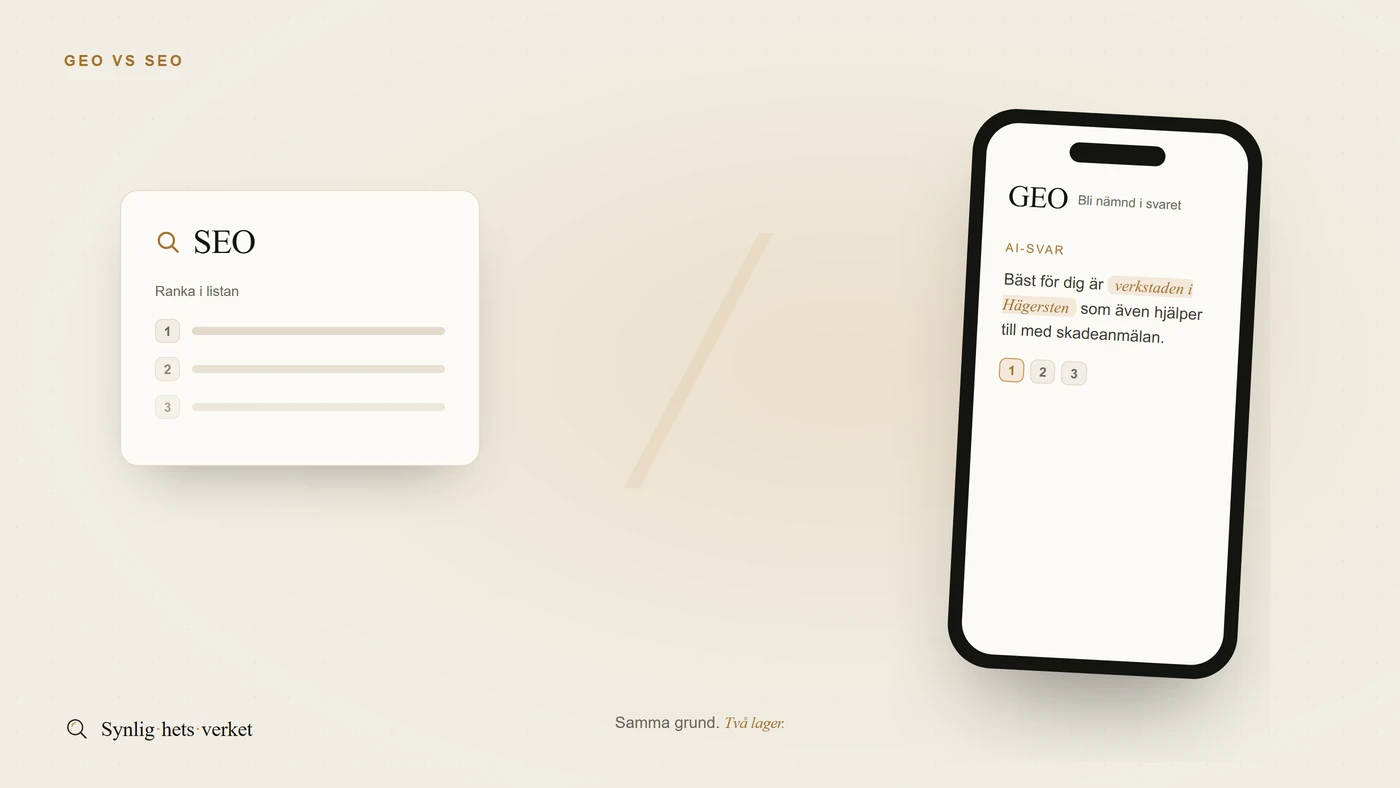
If you have googled “GEO vs SEO” you are probably not after an academic definition. You want to know one thing: are these two different things I have to handle separately, or is it the same thing in new packaging? The answer is somewhere in between, and that nuance is the whole point.
You have heard about SEO for twenty years. GEO is the new thing, loaded with salespeople saying it changes everything. The truth is less dramatic and more useful: they are two different goals that rest on largely the same foundation. Here we go through what separates them, where they overlap, and why you should not choose between them.
What SEO actually means
SEO, search engine optimization, is about ranking as high as possible in the search engines’ list of results. When someone searches for “dentist Uppsala” you want to be among the top hits, because nearly all clicks go to the first results. The further down, the quieter it gets.
In practice SEO rests on three legs. The technical: that the page loads fast, works on mobile and can be read by the search engine’s robot. The content: that you actually answer what people are searching for, clearly and thoroughly. The authority: that other credible sites link to you and that your company information is consistent everywhere it appears.
The goal of SEO is the click. You rank, the customer sees your link, the customer clicks and lands with you. The entire model is built on the customer leaving Google and coming to your page.
What GEO means, and why it showed up
GEO stands for Generative Engine Optimization, that is, optimization for generative search engines. It is the answer to a behavior that barely existed a few years ago: asking an AI instead of googling. When you put a question to ChatGPT, Perplexity, or meet Google’s AI Overview at the top of the results, you do not get a list of links. You get a finished answer, phrased in running text, often with a few source citations.
GEO is about being one of the sources the AI picks up and cites as it builds its answer. That is a decisive difference from SEO. On an ordinary search page there are ten blue links and you can win by being number seven. In an AI answer perhaps three or four sources are referenced in total. Either you are in it, or you do not exist in that answer.
If you want the full picture of the mechanics behind this, we have a dedicated walkthrough of what GEO is. Here we stick to what is relevant for the comparison: GEO aims for the citation, not the click. The customer can get their answer, see your name mentioned as a source and make a decision about you without ever visiting your page.
The difference in one sentence, and why it is smaller than it sounds
The short version: SEO gets you ranked in the list of links, GEO gets you cited in the AI answer. SEO is rewarded with clicks, GEO with mentions.
That sounds like two different disciplines. But look at what each one requires and they start to merge. An AI building an answer needs to get the facts somewhere. It gets them from pages on the web, and it prefers pages that are clear, well structured and easy to interpret. Those are exactly the same qualities that make a page good at classic SEO.
This is where many go astray. They treat GEO as a separate channel with its own tricks, as if it were a new advertising system to learn. But the AI reads the same web that Google does. It largely cites content that already ranks well. Strong SEO is therefore often the prerequisite for being citable at all. They are not competitors for your attention, they are two results of the same work.
The shared foundation
Here are the things that make you both rankable and citable at the same time:
-
Clear language. Write so that a human immediately understands what you mean, without industry jargon and sweeping phrases. Search engines and AI both interpret text best when it is direct and concrete. If a reader has to guess what you are saying, so does the machine.
-
Clean structure. Headings that describe what is coming, short paragraphs, lists where they fit, a clear question followed by a clear answer. That helps Google understand your page and makes it easy for an AI to lift out a passage and cite it.
-
Correct company information. Name, address, opening hours, services and contact details should be consistent everywhere: on the site, in Google Business Profile, in directories. Contradictions make both Google and AI unsure about what is true about you, and uncertainty makes them pick someone else.
-
Content that actually answers. A page that answers a concrete question fully ranks better and gets cited more often than a page that only touches on the topic. Question and answer are the currency in both worlds.
Note that none of this is exotic. It is craft. The difference between a business that shows up in both channels and one that shows up in neither is rarely a secret trick, but whether the foundation is done properly.
Why you need both, not choose
There is a temptation to believe that GEO is about to eat SEO, and that you should therefore drop the old and bet everything on the new. That is an expensive mistake for two reasons.
First, Google is still by far the largest channel. Most searches happen there, and a large part of them still show ordinary link results. To stop caring about SEO means turning down the largest audience you have, in exchange for a smaller one that is growing.
Second, the new channel is built on the old one. Because the AI answers largely cite pages that already rank, it is hard to become citable without first being rankable. Pitting GEO against SEO is like asking whether a house needs a foundation or walls. It needs both, and the walls rest on the foundation.
The honest answer for most businesses is therefore not “switch from SEO to GEO”. It is: make the foundation so good that you become both rankable and citable, and keep an eye on both channels over time. For anyone who wants to hand that part off to someone else, we offer it as AI visibility as a service, but the principle holds regardless of who does the work.
How to think ahead
Stop seeing GEO and SEO as two camps you have to choose between. See them as two ways of getting found that succeed or fail for the same reasons. If you do not rank in Google you are likely invisible to the AI too. If your information is messy and your text unclear you fall away in both.
Build the foundation once, properly: clear language, clean structure, correct information, content that answers. Then the same work does the job for you in the list of links and in the AI answer. It is not GEO or SEO. It is the same visibility, seen through two windows.