Twenty years ago the path to a customer was easy to draw. Someone typed a question into Google, got a list of blue links, clicked one of the top results. Search engine optimisation, SEO, was about a single thing: climbing as high up that list as possible, because that was where the traffic was.
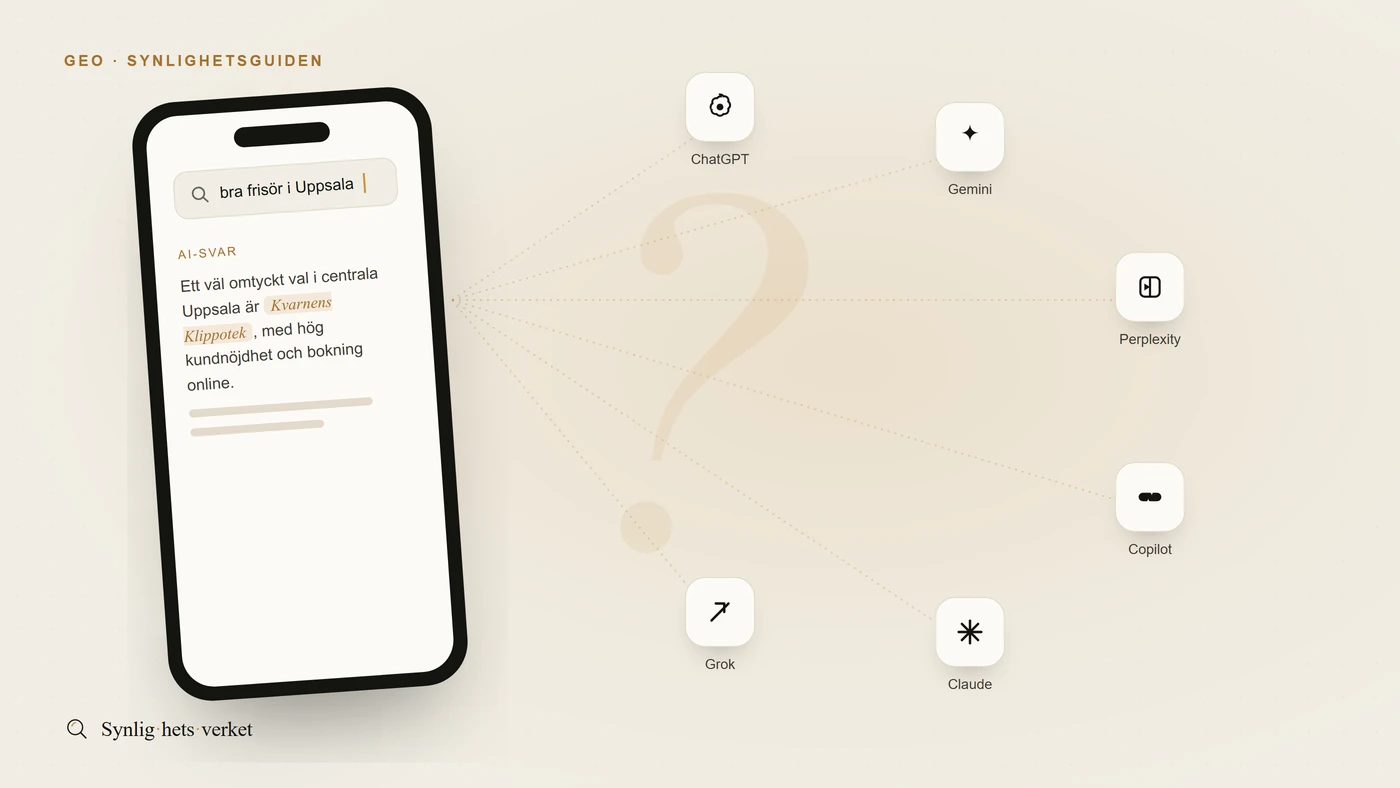
That list is still there. But more and more people never see it. Instead they ask ChatGPT “which is a good hairdresser in Uppsala?”, they write to Perplexity “who repairs stone chips in Hägersten?”, or they read Google’s AI Overview at the top and settle for it. In every case they get an answer, not a list. An answer that mentions certain businesses and says nothing about others.
If your business isn’t mentioned where it should be mentioned, you’ve lost a customer you’ll never find out you lost. That is what GEO is about preventing.
What GEO actually means
GEO stands for Generative Engine Optimization. Where SEO optimises for ranking in a list, GEO optimises for being cited in a generated answer. The goal is no longer just a position, but being one of the sources an AI chooses to build its answer on when someone asks about what you do.
It is the next layer on top of search, not a replacement for it. The list of links isn’t going away. But above it, and increasingly instead of it, there is now an answer that a machine has put together. GEO is the craft of belonging in that answer.
It isn’t a trick, it’s a foundation
The first thing that needs saying, because it is the most common misconception: GEO is not a set of tricks that fools a language model. Models like ChatGPT, Perplexity and Google’s Gemini can’t be manipulated the way old search engines could be gamed with keyword stuffing and bought links.
They build their answers on what is clear and consistent across many sources. An AI that has to answer “who is a good hairdresser in Uppsala” looks for businesses that are described understandably, presented consistently and are credible. If your information is thin, vague or contradicts itself between the website, the Google profile and the directories, you are either left out or described in a way no one can use.
That means the foundation for GEO is almost exactly the same foundation as for good SEO: clear language, clean structure, accurate business information and content that actually answers what people are wondering about. Do the basics well and you become both easier to rank and easier to cite. The difference lies in a few specific choices that strengthen machine readability, rather than replacing the foundation.
How an AI chooses what to mention
To understand what you can influence, you need to know a little about how the answers come to be. Simplified, a model’s knowledge comes from two directions.
Training data. The model has been trained on enormous amounts of text from the web. If your business was described in clear, credible places during that period, the model knows you exist. If you weren’t there, or only as a line without context, you are invisible to that part.
Real-time web search. More and more answers pull in fresh information as they are created. Perplexity searches the web for every question and shows its sources. ChatGPT searches when browsing is enabled. Google’s AI Overview draws from Google’s current search index. That means even a model that hasn’t “learned” about you can find you now, if you exist in the places it pulls from.
In both cases the same tendencies apply. The model prefers sources that are clear, named and consistent, and it prioritises fresh information when the question concerns things like prices, opening hours or range. These are not hard rules, they are patterns. But they are stable enough to be worth working towards.
How to make your business quotable
Five things carry most of the work. None of them is magic.
- Write so that it is impossible to misunderstand what you do. Not “we create opportunities together”, but “we are a hair salon in central Uppsala, specialising in cuts and colour, with drop-in and online booking”. Two sentences that give an AI everything it needs to answer a dozen questions about you.
- Be consistent everywhere. Name, address, categories and description should match across the website, the Google profile and the directories. Conflicting information makes you harder to trust, for both human and machine.
- Add structured data. JSON-LD that describes the business, the services and common questions makes the information machine readable without guesswork. This article, for example, has FAQ schema, precisely for that reason.
- Keep a living FAQ. Real questions with short, self-contained answers are the most quotable format there is. An answer that can be lifted out and read on its own is an answer an AI can reproduce.
- Keep it current. A page that looks recently updated is chosen over one that seems abandoned. GEO is ongoing work, not a one-off effort.
This is the same clarity that keeps a stressed visitor on their phone happy. Machine readability and human readability pull in the same direction. That is the whole point: you don’t write for the robot at the expense of the customer, you write clearly, and both win.
An example that it works
We built a new website for Kvarnens Klippotek, a hair salon in Uppsala, with booking and a structure built for local search and readable for AI. Barely three weeks after launch the salon came up as one of the suggestions in Google’s AI answer to a search for a good hairdresser near Vaksala torg.
It should be said plainly: AI answers vary between users and over time, so this is an observation on a single occasion, not a guarantee. But it shows what the foundation is for. They did nothing with tricks. They simply became understandable, consistent and easy to cite.
GEO and SEO belong together
It would be a mistake to read this as SEO being dead and GEO being the new thing. They are two layers of the same thing. The page that ranks well in the usual list is often the same page the AI answer pulls from, because Google’s AI Overview builds on the ordinary index. If you want to go deeper on the difference, we have a separate walkthrough of GEO vs SEO, and separate guides for ChatGPT, Perplexity and Google’s AI Overview.
What we work on as AI visibility is fundamentally this: making you understandable, consistent and quotable, so you are there when the answer is written. Not by chasing every new platform, but by building a foundation that holds no matter where the question is asked.