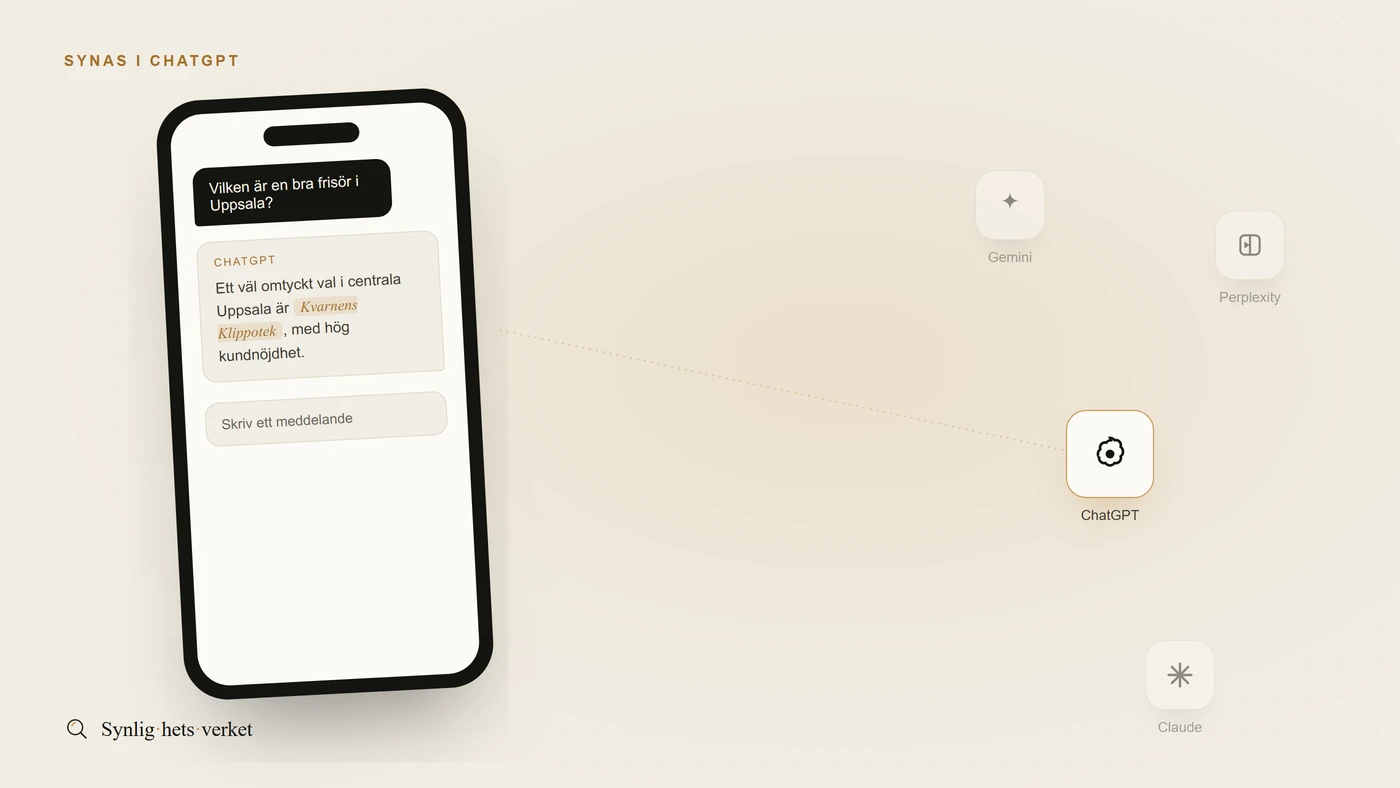
Someone opens ChatGPT and types “which accounting firm in Uppsala would you recommend?” The answer names three. Yours is not one of them. You never find out the question was asked, and the customer moves on with one of the three. This is the new, silent filtering, and it happens without you seeing it.
The question, of course, is: how does ChatGPT decide which names make the cut? And can you do anything about it? The answer to the second question is yes, but not in the way most people think. You cannot write an instruction that makes the model like you. You can make your business so clear and easy to describe that the model names you for the right reason.
Two sources: training data and web search
To understand what you can influence, you need to know where ChatGPT gets what it says. There are essentially two sources.
The first is training data. The model has been trained on enormous amounts of text from the web, and that training determines what it knows about the world up to a certain point in time. If your business was clearly described on the web when the model was trained, traces of you exist in the model. If you did not exist, or existed only vaguely described, the model has nothing to lean on. It does not matter how good you are, only what was written down.
The second source is web search. When browsing is turned on, or when the model judges that a question requires fresh information, ChatGPT fetches pages from the web in the moment and builds the answer on them. Then it matters less what the model learned during training, and more what is published now and how easy it is to read.
The important part: you never know in advance which source is used. Many people use ChatGPT without browsing, and then training data is all there is. Others ask questions that trigger a search. That is why you need to be present in both directions: both in what has already been written about you, and in what can be fetched fresh today.
What you can actually influence
Here it gets concrete. You cannot steer the model. You can steer the material it reads. Those are two entirely different things, and the difference is the whole point.
The material is everything written about your business in places a model can train on or fetch from: your own site, your Google business profile, industry directories, social profiles, articles and mentions. When that material is clear, correct and consistent, the model’s picture of you becomes clear, correct and useful too. When the material is thin, contradictory or vague, the model’s answer is either wrong or absent entirely.
This is the same logic behind what GEO is: generative engines describe what is easy to describe. Your job is not to persuade the model. Your job is to make the material so good that a correct description becomes the easiest possible answer.
Write so that you are easy to describe
Most company pages are written for someone who already knows who the company is. The heading says “We create opportunities together” or “Your partner for growth”. Pretty, but it says nothing about what you do, for whom or where. A human who already knows you fills in the gaps themselves. A language model trying to describe you has nothing to fill in with.
Compare that with: “We are an accounting firm in central Uppsala that helps small businesses and sole traders with bookkeeping, payroll and tax returns. We take on new clients continuously and you can reach us by phone or through our contact form.” Two sentences, and a model can now answer a dozen different questions about you: industry, location, services, target group, how to get in touch.
What you want to achieve is to make it impossible to misunderstand what you are. Spell out the industry in ordinary words. Spell out the location. Spell out who you are for and who you are not for. Spell out how to do business with you. It sounds obvious, and that is exactly why it gets overlooked: it feels too simple to be worth writing down. But the simple is exactly what a model needs to quote you correctly.
A living FAQ is one of the strongest tools here. When you write out the real questions customers ask, and answer them straight, you create text in exactly the format models prefer to pick up: a question and a clear answer. Keep it updated, and it also signals that the page is alive.
Spread the same truth across several places
A single clear sentence on your own site is good. The same truth repeated in five places is much stronger. Models trust what is consistent across several independent sources more than what appears in only one place.
In practice that means:
- Your own site with clear, current text about what you do, where and for whom.
- Google business profile with the right name, category, address, opening hours and services. It is often the source closest at hand for local questions.
- Directories and industry sites where you appear, with the same details as on the site.
- Structured data (JSON-LD) on the site, describing your company in a format machines read directly: name, address, phone, opening hours, services.
The danger is not being too little visible. The danger is being visible inconsistently: an old phone number in a directory, a different company name on Facebook, an address that does not match. Every contradiction makes the model less certain, and an uncertain model would rather skip you than guess wrong. Tidy up so that the same truth appears everywhere.
This work is, in practice, the same thing as building AI visibility: not a single button you press, but a coherent, consistent presence that makes you easy to find and easy to describe.
You cannot hack a language model
There are packages sold that promise to “get you mentioned in ChatGPT” with some kind of trick. Be skeptical. There is no instruction you can hide on your page that makes a model obey you, and modern models are built to resist exactly those attempts. Making up numbers, prices or awards to seem bigger does not work either, because other sources do not confirm the claims, and a model that notices your site does not match the rest starts to trust you less.
Nor is there anyone who can honestly guarantee that you get mentioned. The outcome is owned by the models, and they change, are retrained and swap sources over time. The only thing anyone serious can promise is that the conditions are in place: that you are clear, consistent, technically readable and easy to fetch. The rest is craft over time, not a trick that flips once.
A good way to keep track is to ask the models yourself. Open ChatGPT once a month and type “what is [your company name]?” and “which [your industry] in [your location] would you recommend?” Read what comes back. Are you mentioned? Are you described correctly? If the description is wrong, find out where the incorrect picture comes from and fix the source.
In short
ChatGPT names your business based on two sources: what was on the web when the model was trained, and web search when browsing is on. You cannot steer the model, but you do steer the material it reads. Write clearly about what you do, for whom and where. Keep a living FAQ. Spread the same correct details across your site, your Google profile and directories, and back it up with structured data. You cannot hack a language model. You can become so easy to describe correctly that it names you on its own.