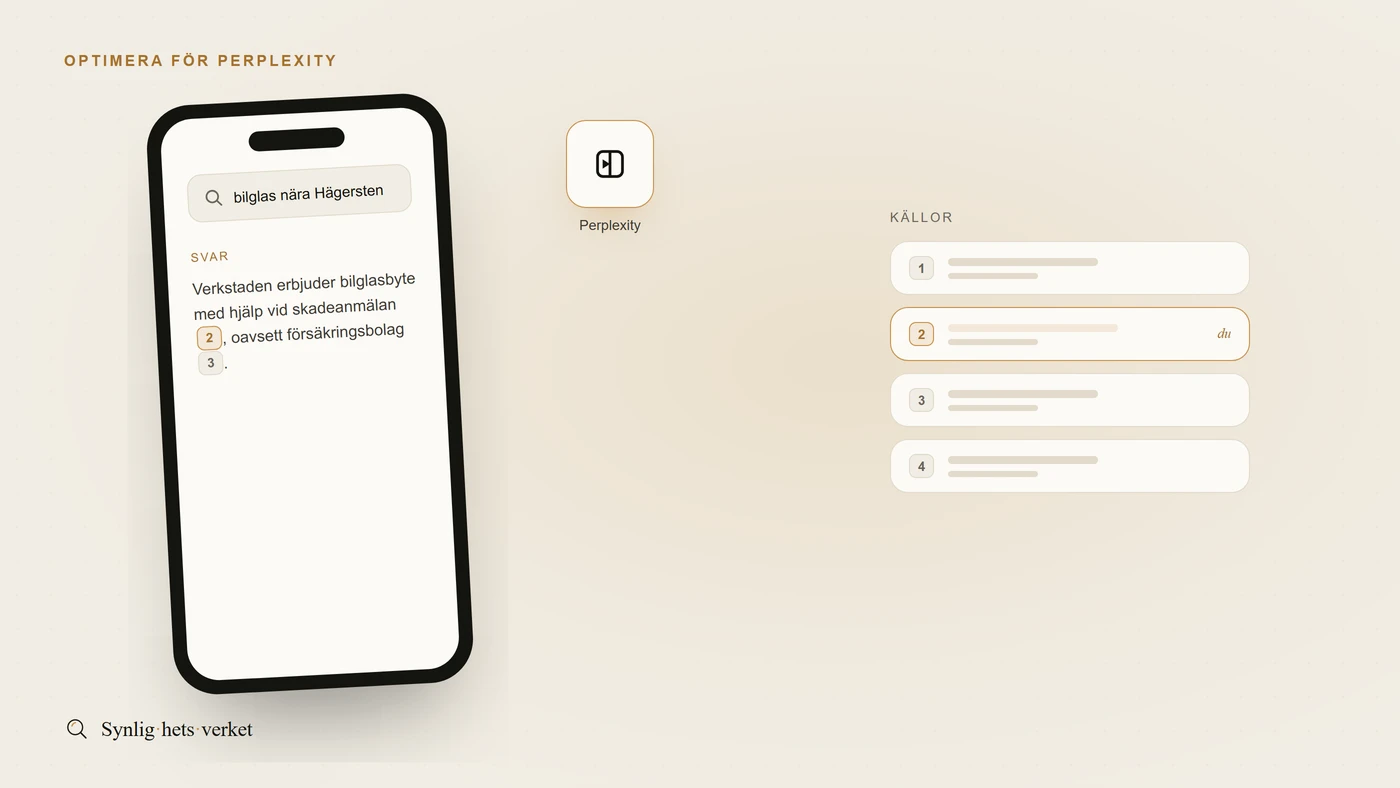
Perplexity is not an ordinary chatbot. When you ask a question, it goes out onto the web, fetches pages in real time and builds its answer from what it actually finds right then. Then it shows the sources openly: numbered, clickable, in the middle of the answer. That is the decisive difference from a pure language model that answers from memory without telling you where the information comes from.
That difference is also your opportunity. If Perplexity reads the web live for every question, then your page can become one of the sources it cites. Provided the page is clear, current and easy to lift a passage out of.
Why Perplexity is the most influenceable AI answer engine
Think of the difference between answering from memory and answering with a reference work in front of you. A pure language model does the former. It has read a large amount of text during training and generates its answer from the patterns it learned. You cannot see which pages sit behind it, and you cannot influence the answer by changing a single page today.
Perplexity does the latter. For every question it formulates one or more web searches, fetches the pages that seem most relevant and summarises them. The sources are listed, often five to ten of them, and the user can click through. That means two things for you. First: your page actually has to be found in the search to be in the running. Second: if it is found and is clear, it can be cited almost immediately, without you having to wait for a model to be retrained.
That is why Perplexity is the most influenceable of the major AI answer engines. You are working against a live search, not against a frozen memory. The same groundwork that gets you found and chosen by people also makes you citable here. If you want the full picture of that work, read our overview of what GEO is.
How a question works in Perplexity, step by step
It helps to understand the chain, because each link is a point where you are either included or dropped.
First, Perplexity interprets the question and makes one or more searches against the web. Then it selects a number of pages to read. After that it reads the content and picks out the parts that answer the question. Finally it writes a coherent answer and attaches source references to the claims it has drawn on.
Where in that chain do you win or lose? You need to be part of the selection, which comes down to classic findability: that your page ranks for the topic. But being read is not enough. Your page also has to contain a part that is easy to lift out. If your answer is spread across five paragraphs, embedded in narrative text and dependent on the context around it, there is a strong chance that Perplexity pulls the clearer answer from a competitor instead. The one who wrote a clean, self-contained passage gets cited. The one who wrote beautifully but vaguely gets passed over.
What makes a page citable
Citability is the core. A citable passage is one that holds up on its own, without the rest of the page around it. What you want to achieve is text that a machine can cut out and reproduce without losing meaning or risking becoming incorrect.
Some concrete traits that help:
- Answer a clear question directly. Put the question in the heading or first sentence, and give the answer right after. Do not save the point for the end.
- Write self-contained passages. Each passage should be understandable without the preceding ones. Avoid “as mentioned above” and “this” that points backwards.
- Be concrete. Name things, give the actual answer, avoid hedging phrases like “it depends” without then saying what it depends on.
- Use plain language. Short sentences and common words are cited more easily and misread less often than convoluted prose.
This is not in conflict with writing for people. On the contrary. A visitor skimming your page wants exactly the same thing: the answer, clearly, quickly. When you write for citability you also write for readability.
Currency: the factor most people underestimate
Because Perplexity searches the web in real time, currency carries weight. A page that was updated recently signals that the information still holds, and for many questions the answer engine prefers fresh material over old. A page that has not been touched in several years can still be cited, but it competes uphill against newer sources that say roughly the same thing.
The practical advice: keep your most important pages alive. Review prices, opening hours, services and years so that nothing is obviously out of date. When something actually changes, change the page (and feel free to note when it was last reviewed). This is not about dressing it up with false “updated today” dates, but about your information matching reality. A page where the year, the price or the offering no longer holds is a page that makes itself less citable, because the AI answer is only as reliable as the source behind it.
Structure, structured data and consistent business information
Three more technical things make it easier for Perplexity to understand and trust your page.
Clear heading structure. A logical hierarchy of headings works like a table of contents. It lets a machine quickly locate which part of the page answers the specific question being asked. A heading phrased as the question people search for makes the connection even clearer.
Structured data. Markup in the page’s code (for example schema for organisation, article or frequently asked questions) states explicitly what the content is: who is behind it, when it was published, which question a passage answers. It removes guesswork and makes your page easier to interpret correctly.
Consistent business information. Name, address, contact details and description of what you do should look the same everywhere: on the website, in your Google profile, in directories. When the details match from source to source they become easier to verify, and a verifiable detail is one an answer engine can cite more confidently. When they diverge you sow doubt, and doubt makes you less useful as a source.
If you want someone to take full responsibility for this work for you, that is exactly what we mean by AI visibility: making your business into something the AI answer engines can find, understand and cite.
Summary
Perplexity differs from a pure language model in a way that matters for you: it searches the web for every question and shows its sources openly. That makes it the AI answer engine you can most directly influence. You become one of the numbered sources by writing clean, self-contained factual passages that answer a clear question, by keeping the pages current, through a logical heading structure and structured data, and by keeping your business information consistent everywhere. None of it requires tricks. It requires that your page actually is the clearest, most current and most citable source on the question. Write for that, and you get cited.